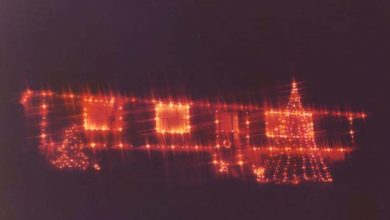
Freakonomics talks about Christmas Lights
Would you pay a professional $2,500 or more to put up your holiday lights?
Freakonomics ‘The Economics of Everyday Things’ did an episode on Christmas lights. About 15 minutes in you get to hear a little from Chuck Smith at PlanetChristmas.
Listen to the podcast at the Freakonomics website, or look for episode 119 on Spotify or Apple Podcasts.
For the audio-challenged, here’s the transcript pulled from the Freakonomics website:
* * *
‘Twas a day in the winter of 1991. Dean Lyons was working construction, and it was no fun.
LYONS: I’m framing houses. I was probably making seven, eight bucks an hour maybe. A guy walked across the street, and he’s like, “Hey, I need you to use your ladder and pull the lights off my roof.” I jump down and help him do it, and then he handed me a twenty dollar bill. It took me literally ten minutes, and I was like, “Well I just made twenty dollars in ten minutes. And that’s really interesting because I’m slaving all day to make fifty bucks!”
A couple years later, Dean was pre-med. But the thought of Christmas lights still danced in his head.
LYONS: I’d taken all the med classes, studied for the MCAT, the whole thing. And I said, “Yeah, I’m starting a Christmas lighting company.” And my wife’s like, “Wait, are you sure you don’t want to take a job that has health benefits and everything?” No. I’m doing Christmas, babe. Went to the ace hardware, bought the ladders, and just grabbed lights off the shelf. I found a guy who made me this cheesy little flyer. And then I walked around the neighborhood of some of the bigger houses in town. The phone just went off the hook. Within the first year of doing it, we did seventeen thousand dollars in revenue. And that was in two months.
Lyons eventually grew his empire. And today, he puts lights up for many a buyer.
LYONS: There’s a moment you transform people’s houses from dark and dreary. And then you put lights on two trees, and a roofline, and some on the columns. You turn that on at night and people just go crazy for it.
For the Freakonomics Radio Network, this is The Economics of Everyday Things. I’m Zachary Crockett. And don’t worry: I’m not going to be doing this whole episode in rhyming couplets. Today: Christmas lights.
* * *
In many suburban neighborhoods, you’ll see signs plastered all over the place offering to put up Christmas lights on your house.
Some of these businesses are pest control or lawn care companies looking for a little extra seasonal income. But there are also dedicated businesses that make all of their money during the holidays.
LYONS: My name is Dean Lyons and I’m the founder and CEO of Bright Nites lighting company.
When Lyons launched Bright Nites in the early ‘90s, selling residential Christmas lighting as a service was a new idea. At first, he did local jobs in wealthy enclaves in Utah. Today, his company has branches in cities all over the U.S.
LYONS: LA, Bay Area. Phoenix. We’re all over Miami. Up and down the east coast, North Carolina, jumping up to Philly, all those areas up in the northeast there. New York. Connecticut.
In each city, Bright Nites has territory managers, sales teams, and hundreds of seasonal workers who put up lights. The company does some commercial gigs for municipalities and businesses — golf courses, hotels, car dealerships, and corporate headquarters. But the residential jobs make up the bulk of the business.
Professional holiday lighting is brutally competitive. And Lyons has a multi-pronged approach to marketing.
LYONS: So we have a lot of SEO, we have a lot of Google ads, paid ads. And then we’re sending out hundreds of thousands of dollars of direct mail that’s been refined for the right neighborhoods.
The “right neighborhood” is typically a well-to-do suburb, where people have more disposable income than free time.
LYONS: Lots of doctors, business owners. People don’t want to do it themselves. They don’t want to get on a ladder. Our direct mail campaign is built around home values. We have it down to a science.
CROCKETT: When you land a client in a neighborhood and their house looks great, does that then lead to a snowball effect in that neighborhood?
LYONS: Yeah, we have cities that we own because of that. Any time you get one good house in the neighborhood, lights turning on literally is your number one source of new revenue.
For Bright Nites, Christmas lights are a year-round business.
LYONS: Through the off season, we’re ordering your lights, finding new recruits, filling out what territories or what new cities we’re going to open. Every year it seems to be getting earlier.
CROCKETT: What’s the earliest request you’ve ever had to put up Christmas lights?
LYONS: We put up lights in September. Summer’s over, it’s time for, you know, getting going on it. It really goes crazy after Halloween. As soon as Halloween’s over, it’s full throttle.
During any given day during the holiday season, Bright Nites has seventy teams out installing lights on homes across the country. Like most lighting companies, they use their own commercial grade lights. These lights are much more durable than the ones you buy at the store. And they also allow Bright Nites to save time sifting through jumbles of strings in customers’ garages.
LYONS: They get lost or, you know, piled up with dust and then we show up on you know November 10th and they’re like, “Oh my, well my lights are way up on that top shelf and I got fifty other boxes on top of them, so you got to dig them out and pull them down.”
Bright Nites works at such a high volume that they manufacture their own Christmas lights in China. They order them in huge spools, and cut them to the perfect length for each house’s needs.
LYONS: On the roof line, it’s custom cut. The guys just pull it off, cut it, bulb it up, and then install it and then wire it all in.
A lot of holiday lighting businesses charge by total length — say, $10 bucks per foot of lights. Lyons chooses to estimate the cost of a job based on the total number of strings it will require.
LYONS: We’ve tried footage. It’s just really hard because it’s just the way the guys install the lights. One guy might put in a little bit more of a space between the lights and that throws it off.
Over the years, Lyons and his team have gotten pretty good at estimating how many strings of lights a house will need just by looking at it. But his team is currently developing a tool that uses artificial intelligence to take the guesswork out of the job.
LYONS: We are going to develop a camera — you hold it up to the tree and it will tell you the number of lights that that tree needs.
At Bright Nites, a basic residential Christmas light package generally costs around $2,500 bucks. That includes the lights, the set up, the takedown, and off-site storage of all the decor through the rest of the year.
LYONS: Twenty five hundred dollar job is a roof line, you know, couple hundred feet of roof line, and that actually looks really nice. And then probably two ten foot trees in the front of the house. And then maybe some lights spiraled around your front columns.
But some jobs are much larger.
LYONS: Lots of twenty thousand, thirty thousand dollar jobs, fifties. I mean, we have a client who spends well over four hundred thousand on his yard.
CROCKETT: What the hell does a four hundred thousand dollar job look like?
LYONS: Yeah, it’s gingerbread style on every house on the grounds. It’s a three hundred acre parcel. So every window, every garage door, every peak on a big house. I’m talking big houses. The garages. The detached barns. You’re getting thirty foot tall Christmas trees that we fabricate and we bring them in and stand them up on the grounds. And lighting on most trees on the property. So when you drove in, it’d be almost like you’re driving through your own like a little town of decor.
A job like that could take several weeks to complete. A typical $2,500 job can be done by a two-person crew in around 2 hours.
LYONS: We literally have mathematical calculations on how much each crew will install in a day. A roof line — let’s see, a hundred feet an hour. Guys in trees hanging thirty strings is roughly an hour.
During a busy holiday season, lighting crews have to be extremely efficient to fit in all that work. In fact, Bright Nites has an internal app that tracks every job in progress.
LYONS: You can look on the computer screen and see every truck that we have with GPS, you can pull up on the client’s house and see how far they are through the job, and how much time they have left before they need to be on the next job.
But optimizing for speed isn’t just about how quickly the crews work. It’s about standardizing the lighting design so it can be replicated consistently.
That’s coming up.
* * *
If you walk around any American suburb during the holiday season, you’ll eventually encounter someone like Chuck Smith.
SMITH: Every city has at least that one guy with the over the top display during Christmas. I’m a Christmas light lover.
For Smith, Christmas lights are a lifelong obsession.
SMITH: You know, when I was a kid, my father would always drive us all over town looking at houses decorated with Christmas lights. I became convinced that the people that decorated their houses with lots of lights, that just meant that Santa Claus would see their house first when he was making his rounds. And so that year I remember convincing my dad that we had to decorate for Christmas.
Smith eventually became an electrical engineer. He continued to decorate for Christmas in his adulthood. And for many years, he put on one of the most famous Christmas light displays in the country at his home in the suburbs of Franklin, Tennessee.
SMITH: I was up to, I think the last count was 260,000 lights on my house. People would come literally from other states. And I actually had people come from other countries just to see my house. And I was having to hire off-duty police officers to handle the traffic around my house.
Smith says the Christmas lights people put on their homes today have come a long way. When he was at the peak of his decorating 20 years ago, nearly all Christmas lights were incandescent. Those bulbs are illuminated by wire filaments that heat up — and they use a ton of electricity.
SMITH: In the early days when everything was incandescent, we always hated to go out and look at our electrical meters because a little top in there would be spinning it very, very fast. The electric company ends up liking you a whole lot.
But these days, most Christmas lights, including those used by professionals, are LED. They use semiconductors to emit light, and are far more energy efficient.
SMITH: LED-based lights only use like ten to twenty percent of what an incandescent light uses. You can put a lot more lights in your display and use a lot less electricity.
A house with 600 feet of incandescent lights along the roof and on a few trees and shrubs used to add around $200 to an electric bill. That same house uses less than $30 with LED bulbs. LED technology also allows for more creativity. The newest innovation in holiday decor is something called RGB pixel lighting.
SMITH: RGB means red, green, blue. And so you can now control the colors of each light. People put up these things they call pixel trees. You have all these vertical strips to make it look like a tree, but each strip is full of pixels, so you can now start scrolling words and pictures and just about anything that you can think of. Twenty foot tree, you end up paying about seventy thousand dollars for it.
But it’s usually the case that amateur decorators like Smith are a bit more creative than the professional installers. Smith is also the founder of a website called Planet Christmas, which was at one time the largest forum for Christmas light enthusiasts on the Internet. He’s spent a lot of time talking to people who run Christmas lighting companies. And he says the professionals have converged on a very specific aesthetic.
SMITH: The guys that do this for a living, they train all their people to decorate the exact same way. So you say you want to wrap a tree in lights, then we all know that the spacing between the strings of lights on a tree is four inches, which happens to be the width of your palm. And then if you put lights in bushes, you put them in a certain pattern up and down or back and forth. And the reason they do that is if there is a problem mid-season, you have to replace a string of lights, you can send another employee out to that site. The vast majority of professionally done installs are all white lights. If it’s all the same color, then it makes it much easier on the company because they have to stock fewer unique parts. And usually the lights always outline the roof edges and always include the bushes out front and a wreath on the door. All white lights. It’s a very consistent look. If you have a crew of people and you have a hundred houses to install, you want to have that crew as efficient as possible.
Dean Lyons says that more than 80 percent of Bright Nite’s customers opt for white lights over color. And apart from the lights, most jobs just involve a wreath, or some garland.
LYONS: It’s kind of like the In-N-Out burger. We don’t have a lot of different products. We do big jobs, little jobs, shrubs, handrails, garage — everything gets done with just those few items.
But a simple job can still be tough to pull off effectively. Take, for instance, a tree in the front yard.
LYONS: We’re going to wrap every branch on all the trees, and there’s not going to be any space that doesn’t have lighting. Because it just looks magical and the more points of light that you look at through your human eye, the more joy you feel. You go out the branch, you come back down the branch. You go up the trunk, out to the next branch to the end, then back down.
CROCKETT: And let’s say you’ve got like a fifty foot tree, lit all the way to the top. Do you ever bring in like a crane or something?
LYONS: Yeah, we have lifts on our truck beds. We do a lot of ladder work on trees up to thirty feet. Above thirty you should have a lift.
Putting lights up is only one part of the job. The price that Bright Nites charges includes takedown, too. That usually happens in January or February.
LYONS: That’s actually the best time of the year. The strike comes down quick. Like, you can get a job down in an hour, maybe. That’s it. They’re just grabbing that stuff, rolling it up and putting it in boxes.
Those boxes are labeled and taken to regional storage facilities that Bright Nites maintains all over the country.
LYONS: We have a large storage space in every city and the lights go into a box with the name and they just get reused again year after year.
CROCKETT: What happens if the customer doesn’t come back the next year? You have this perfectly cut string that fits one person’s house that you can’t use again, right?.
LYONS: There’s good business in recycling lights. You can get, at some points, a buck per pound or whatever. Because it’s just all copper and you just get all that copper recycled.
A small, local Christmas lighting company might just pay one or two guys minimum wage to drive around town. But at the scale of a company like Bright Nites, the overhead is much more substantial.
LYONS: We have hundreds of installers and managers, so there’s millions in payroll just on that. You order several containers out of China every year, you’re spending, you know, seven figures to get all those lights here. And then have those on the shelves in every city we do work in. Seventy trucks on the road at any given time. Fueling those trucks, you know, sixty, seventy, ninety days.
Chuck Smith says a lot of lighting companies — particularly, the smaller companies that pop up every winter — will encourage clients to sign three-year contracts to make the numbers work.
SMITH: The person doing the decorating — usually that first year he’s lucky to break even at all because he’s had to purchase all the lights. But then the second year, all the person is doing is just going out and hanging your decorations for you. And by the third year you’re just kind of ginning money left and right. It becomes quite profitable for these companies after a while.
After all expenses are considered, Lyons says Bright Nites typically nets a 10 to 20 percent profit margin. And that’s not a bad business, considering that they do more than 2,000 jobs each season, at an average of a few thousands dollars per job. It’s also, as it happens, a trade that holds up pretty well through tough times.
LYONS: Man, I’ve been through like three recessions. And people still did lighting. And we’ve never really struggled.
In Lyons’s estimation, that’s a testament to the value of decorating a home for the holidays.
LYONS: I think that people actually get mesmerized by the lights. It just is like, “Let’s forget about whatever’s happening and let’s just enjoy these lights for a few minutes.”
For The Economics of Everyday Things, I’m Zachary Crockett.
* * *
This episode was produced by me and Sarah Lilley, and mixed by Jeremy Johnston. We had help from Dalvin Aboagye. And again, if you want to keep up with the future of the show, please subscribe to our email list at zcrockett.com.
SMITH: The sad part about it is that my display was so over the top that people in my neighborhood stopped decorating because they knew they could not compete with what I was doing.